
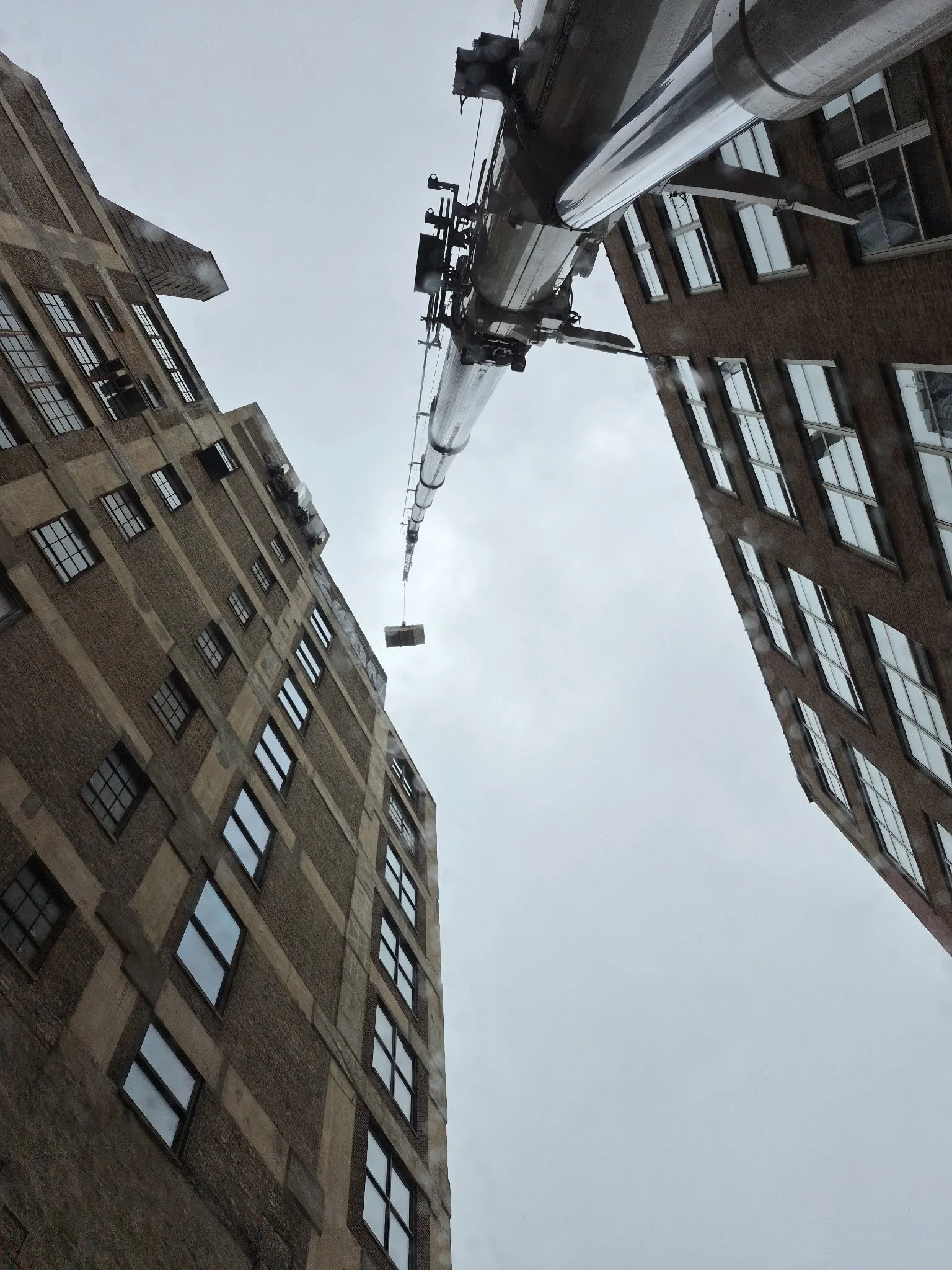
Getting a crane permit in Chicago: CDOT fees, lead times and what goes wrong
When a Chicago crane job needs a CDOT permit, what it costs per foot, how far ahead to apply, and what holds permits up.
By Riley Pettrone, lead lift planner at 123 Crane Service
A crane might only be on your street for a few hours, but the permitting and planning behind it can take weeks. This is what I'd want a contractor to know before calling, based on my experience coordinating crane operations, street closures and permits throughout Chicago.
When a crane job needs a CDOT permit
Any time a crane operation occupies or obstructs the public right-of-way, you need a permit from the Chicago Department of Transportation (CDOT). That includes sidewalks, curb lanes, traffic lanes, bike lanes and alleys.
If the crane sets up entirely on private property and doesn't obstruct the public right-of-way, a CDOT street closure permit generally isn't required. The crane may still need separate travel permits depending on its weight, dimensions and route.
Chicago also has restrictions on setting crane outriggers on public sidewalks. Contractors routinely do it, but that doesn't necessarily mean it's permitted. Outrigger placement needs to be addressed during the permitting process.
If the work is for the City of Chicago or another government agency, CDOT may waive certain permit fees.
Who pulls the permit, and what's needed from you
Usually the crane contractor pulls its own street closure permit.
If the general contractor already has a permit for part of the public right-of-way, we can coordinate our permit with theirs so nobody pays twice for the same space. Say the GC already has the sidewalk and curb lane, but the crane needs the sidewalk, curb lane, traffic lane and opposite curb lane. We can apply in conjunction with the GC's existing permits, subject to CDOT approval.
The most important thing we need from the customer is the building permit, if the work requires one. The City decides which construction activities require building permits. In my experience, when the underlying work requires one, CDOT won't issue the crane street closure permit until it's provided.
We also need:
- The jobsite address
- The scope of work
- The anticipated lift date
- The required work area
- Any existing street or sidewalk permits
How far ahead to call
Call as early as you can. These are the lead times I plan around:
| Situation | Lead time |
|---|---|
| Straightforward permit, no temporary no-parking signs or complicated coordination | As little as one business day |
| Temporary no-parking signs required | Apply at least four business days ahead |
| CTA buses need to be rerouted | CTA asks for at least two weeks' notice |
| Aldermanic coordination, engineering, ground-penetrating radar (GPR) or crane placement surveys | Several weeks |
| Projects with heavy engineering and site preparation | A month or longer |
What a crane permit costs in Chicago
Chicago doesn't have one flat fee for crane street closures. CDOT charges by the type of obstruction, the linear footage occupied, the duration, and whether the work is inside or outside the Central Business District (CBD).
According to the 2026 CDOT permit fee schedule, these rates apply to one-to-three-day closures:
| Closure type | Outside CBD | Inside CBD |
|---|---|---|
| Partial sidewalk | $1.25/ft | $2.50/ft |
| Full sidewalk | $2.50/ft | $5.00/ft |
| Bike lane | $2.50/ft | $5.00/ft |
| Parking lane | $6.00/ft | $12.00/ft |
| Traffic/bus lane | $12.00/ft | $24.00/ft |
| Alley, 10 ft unobstructed | $3.00/ft | $6.00/ft |
| Alley, under 10 ft unobstructed | $6.00/ft | $12.00/ft |
If a crane needs 100 linear feet of full sidewalk, parking lane and traffic lane for one day, the occupancy fees come to about $2,050 outside the CBD or $4,100 inside it.
That's before the rest of the bill:
- Application fees.
- Traffic control. Barricades, flaggers and signage are priced by the number of people, the type and quantity of barricades and signs, and the duration. A simple curb lane closure costs far less than a full street closure with multiple flaggers, extensive barricading and detour signage. All of it has to comply with CDOT requirements and the Manual on Uniform Traffic Control Devices (MUTCD).
- Parking meters. The City charges for the metered spaces affected, and rates vary across Chicago.
- Police details, if they're required.
Parking enforcement can still ticket vehicles inside your permitted work zone, even when you've paid the City for those spaces. Chicago's metered parking runs under a private concession agreement, which makes these tickets particularly frustrating to sort out. Don't assume one can simply be waived.
What holds up or kills a permit
These are the biggest obstacles I've run into:
- CTA bus reroutes, which need extra coordination and advance notice.
- Aldermanic coordination, particularly in residential areas or for full closures that affect access to local businesses.
- Conflicting permits, when another contractor already holds the same street or work area.
- Downtown moratoriums, which restrict construction and street closures in the CBD during certain periods.
- Missing building permits, when the work requires one and the customer hasn't obtained it.
- Special events, since parades, festivals and races can prevent a closure from being approved.
- Engineering and site investigations, including GPR, outrigger load calculations, ground-bearing evaluations and crane placement surveys, which can take weeks.
Towing is another major one. If vehicles are parked in the work zone on lift day, the City generally won't tow them until the posted no-parking restrictions take effect, and even when towing is authorized, the City isn't always quick to respond. Meanwhile the crane, operators, riggers, trucking and an entire construction crew are standing around. That downtime can cost thousands of dollars.
Lifts near the L tracks and in alleys
Crane operations within 50 feet of CTA elevated tracks need additional coordination with CTA. Depending on the operation, CTA flaggers and other safety measures may be required. Identify this early, because it can significantly affect both the schedule and the cost of the lift.
Alleys also need permits when the crane occupies the public right-of-way. The bigger problem is usually overhead: many Chicago alleys are full of electrical lines, communication cables, poles and other obstructions. An alley can be wide enough to fit a crane and still not have enough clearance to operate it safely. Alley lifts are often much more complicated than they first appear, and in many cases they aren't practical.
The job on Halsted where the signs disappeared
One of the most frustrating crane jobs I've dealt with was at 2020 N. Halsted Street in Chicago. We were mobilizing a 160-ton all-terrain crane to set rooftop mechanical equipment.
The permit process took about four weeks because we had to coordinate the street closure and CTA bus reroutes with CDOT and CTA. Everything was approved, and the City posted temporary no-parking signs throughout our designated work zone.
Then someone tore down all the signs before the scheduled lift. On lift day, the entire street was full of parked cars. The people who parked there probably had no idea they weren't supposed to.
We showed City towing personnel our approved permit, but they refused to tow because the no-parking signs weren't posted. We contacted the police, and they couldn't do anything either. The City couldn't provide a solution, and we had no choice but to cancel the lift and reschedule.
We had already incurred the expenses of mobilizing a 160-ton crane, operators, crews and equipment. The City agreed to waive the permit fee for the rescheduled date but didn't reimburse us for any of the costs. We were left holding the bag on a substantial financial loss, despite having followed the permitting process correctly.
So send someone to the site the day before the lift to verify the no-parking signs are still posted, then get there early on lift day to make sure the work zone is clear. Don't assume that just because you have an approved permit, the street will actually be available when your crane arrives. That's a lesson we learned the expensive way.
Planning a crane lift in Chicago?
123 Crane Service plans the lift, coordinates the crane through vetted crane companies, and handles the street permit if the crane sits in the public way. Call us at (312) 313-9070. We are the perfect people to get it done.
You can also see our Chicago crane rental page and crane rental FAQ. If it's a rooftop unit, here's how we handle HVAC crane lifts.

How to Save Money on Crane Rentals Without Sacrificing Safety
Crane rentals can get expensive fast, but cutting corners can lead to accidents, delays, and costly mistakes. The good news? You can save money without sacrificing safety by using smart planning, choosing the right crane, and avoiding hidden fees. In this guide, we break down the best ways to optimize crane rental costs while keeping your job site safe and efficient. Read on for expert tips! 🚧💰🏗️
Let’s be real—crane rental costs can eat up a huge chunk of your construction budget. But cutting corners on crane operations? That’s a fast track to disaster. The good news? You don’t have to choose between saving money and staying safe. There are smart ways to cut crane rental costs while keeping your job site OSHA-compliant and accident-free.
In this post, we’ll break down money-saving strategies that help you optimize your crane rental, avoid hidden fees, and ensure your heavy lifting operations run smoothly. Whether you're a small contractor or managing massive construction projects, these tips will help you maximize your budget without taking unnecessary risks. 🚧💰
1. Plan Ahead: Time is Money in Crane Rental
Crane rentals work like hotels—the longer you keep one on-site, the more you pay. That’s why planning is everythingwhen it comes to saving money on crane rental services.
✅ Tips to Optimize Crane Rental Time:
✔ Know your lift schedule – Don't rent a crane before the job is actually ready.
✔ Stack tasks together – Need multiple lifts? Schedule them on the same day to avoid multiple rental charges.
✔ Coordinate other trades – If steel erection, HVAC installation, and roofing need the crane, make sure they're ready to go back-to-back.
✔ Book in advance – Last-minute rentals can be more expensive due to limited availability.
🔹 Pro Tip: Some crane rental companies offer discounts for multi-day rentals instead of paying per hour. Always ask about pricing structures to get the best deal.
2. Choose the Right Crane for the Job
Bigger isn’t always better—especially when it comes to crane rentals. If you rent the wrong crane, you could end up paying way more than necessary.
⚡ How to Pick the Right Crane & Save Money:
Boom truck cranes are cheaper and great for light to medium lifts.
Rough terrain cranes are perfect for off-road sites but cost more than standard mobile cranes.
All-terrain cranes are versatile but expensive—don’t rent one if a smaller crane can do the job.
Crawler cranes are great for long-term projects, but daily rentals can be costly.
🔹 Pro Tip: Always consult with your crane rental provider—they can help you pick the most cost-effective crane for your job.
3. Avoid Hidden Fees & Extra Charges
Crane rentals can come with sneaky costs if you're not careful. Here’s how to avoid them:
🚨 Hidden Costs to Watch Out For:
⚠ Mobilization Fees – Transporting the crane to your site can cost thousands. Get quotes upfront.
⚠ Overtime Charges – Some companies charge extra if you use the crane past standard hours.
⚠ Permits & Road Closures – Some cities require permits for crane operations. Don’t get blindsided.
⚠ Standby Fees – If your crew isn't ready, you might be charged for downtime.
🔹 Pro Tip: Ask for a detailed quote upfront. Some rental companies bundle mobilization, permits, and setup into one flat rate, which can be cheaper than paying for each separately.
4. Work with an Experienced Crane Operator
A bad operator can turn a simple lift into a costly nightmare. Skilled crane operators work faster, make fewer mistakes, and prevent costly accidents.
🎯 Why Hiring a Pro Saves Money:
✔ Faster lifts = Less rental time – A skilled operator moves loads efficiently, reducing rental hours.
✔ Fewer mistakes = No damage costs – A pro won’t drop a load or damage materials, saving you from costly delays.
✔ Safety-first mindset – Fewer accidents mean no lawsuits, insurance claims, or OSHA fines.
🔹 Pro Tip: Some rental companies provide cranes with operators included. This can be more cost-effective than hiring a separate operator.
5. Schedule Crane Maintenance for Long-Term Rentals
If you’re renting a crane for a long-term project, make sure it’s regularly maintained to avoid breakdowns.
🛠 How Maintenance Saves You Money:
A well-maintained crane works faster & smoother.
Unexpected breakdowns mean costly delays and extra rental fees.
Rental companies may charge repair fees if they think you misused the crane.
🔹 Pro Tip: Always check the crane rental contract to see who's responsible for maintenance. Some companies include routine maintenance at no extra cost.
6. Consider a Crane Rental Partnership
If you rent cranes often, it might make sense to partner with a crane rental company.
🔄 Benefits of a Rental Partnership:
✔ Discounted rates for repeat customers
✔ Priority access to cranes during busy seasons
✔ Better contract terms with flexible scheduling
🔹 Pro Tip: If you frequently rent from the same company, ask about loyalty discounts or bulk pricing.
Final Thoughts: Save Money the Smart Way
Saving money on crane rentals isn’t about cutting corners—it’s about being smart. By planning ahead, choosing the right crane, avoiding hidden fees, and hiring a skilled operator, you can cut costs without sacrificing safety.
If you're looking for affordable crane rentals with licensed operators and clear pricing, 123 Crane Service can coordinate it for you. Call us at (312) 313-9070. We are the perfect people to get it done.

Crane Rental vs. Buying: Which is the Best Choice for Your Construction Business?
Deciding between crane rental and buying a crane? Both options have advantages, but choosing the right one depends on your budget, project scope, and long-term needs. Renting provides flexibility, cost savings, and access to multiple crane types, while buying is a solid investment for large-scale, ongoing projects. In this guide, we break down the costs, maintenance, and job flexibility factors to help you make the best choice for your construction business. Read on to find out which option works best for you! 🚧🏗️
If you’re in the construction or heavy lifting industry, you know that cranes are a massive investment. The big question is—should you buy a crane or rent one? While owning a crane gives you full control over your equipment, crane rental services provide flexibility and lower upfront costs. But which option makes the most sense for your business?
In this blog, we’ll break down the pros and cons of crane rental vs. buying, covering everything from cost considerations to maintenance and job flexibility. Whether you’re a growing contractor or an established construction firm, making the right decision can save you time and money in the long run.
1. Upfront Costs: Renting vs. Buying
One of the biggest factors in choosing between crane rental and purchasing is cost.
A. The Cost of Buying a Crane
New cranes can cost anywhere from $100,000 to $3 million, depending on size and capabilities.
Financing a crane requires down payments, interest rates, and loan commitments.
Depreciation reduces the crane’s value over time, affecting resale potential.
B. The Cost of Renting a Crane
Crane rental costs vary but typically range from $200 to $1,000 per hour for small cranes and $5,000+ per day for larger cranes.
No long-term financial commitment—you only pay for what you use.
No maintenance costs, storage fees, or insurance overhead.
Winner: If you need a crane for occasional projects, renting is the way to go. If you run large-scale, ongoing construction jobs, buying may be a worthwhile investment.
2. Maintenance & Storage Costs
A. Owning a Crane
Routine inspections, repairs, and part replacements can cost thousands annually.
You’ll need a certified crane mechanic on payroll or hire an outside service.
Cranes need secure storage when not in use—another added cost.
B. Renting a Crane
Maintenance is handled by the crane rental company, meaning no unexpected repair bills.
No need for expensive storage facilities or transportation logistics.
Winner: Renting eliminates the stress and costs of crane maintenance and storage.
3. Job Flexibility & Equipment Variety
A. Renting a Crane Offers More Options
Need a mobile crane for one job and a tower crane for another? Renting gives you access to the exact crane type required.
If your project demands specialized equipment, rental companies offer boom trucks, rough terrain cranes, crawler cranes, and more.
Short-term projects don’t require a long-term investment in a single machine.
B. Buying a Crane Limits Your Options
Once you buy, you’re stuck with one crane type, even if another would be more efficient for different jobs.
Your projects must align with your crane’s capabilities, or you’ll end up renting additional equipment anyway.
Winner: For versatility and adaptability, renting is the better option.
4. Operator & Compliance Considerations
A. Crane Ownership Requires Certification & Training
If you own a crane, you’ll need a certified crane operator—another salary to pay.
Cranes must meet OSHA safety regulations, which means regular inspections and compliance paperwork.
B. Renting a Crane Often Includes a Certified Operator
Many crane rental services provide certified operators, eliminating the need to hire full-time staff.
The rental company handles compliance, so you don’t have to worry about industry regulations.
Winner: Renting saves time and ensures you have a skilled, compliant crane operator on the job.
5. Long-Term ROI: When Does Buying a Crane Make Sense?
If your company runs large-scale, ongoing construction projects that require cranes daily, purchasing might be a good long-term investment. Consider buying if:
✔ You have consistent crane usage across multiple projects.
✔ You can afford the upfront cost and maintenance expenses.
✔ You want to rent your crane out when not in use to generate extra income.
However, if you only need a crane occasionally or for different job types, crane rental services offer cost savings, flexibility, and convenience.
Final Verdict: Should You Rent or Buy a Crane?
✅ Rent a Crane If:
✔ You need flexibility in choosing different crane types for various jobs.
✔ You want to avoid maintenance, storage, and operator certification costs.
✔ You don’t use cranes frequently enough to justify ownership.
✅ Buy a Crane If:
✔ Your company requires cranes on a daily basis for multiple projects.
✔ You have the resources to handle maintenance, storage, and compliance.
✔ You plan to rent out the crane when not in use to generate extra revenue.
For most contractors and businesses, crane rental is the smarter financial move. It provides access to top-of-the-line equipment without the long-term investment, allowing companies to stay competitive without breaking the bank.
If you’re looking for reliable crane rental services, 123 Crane Service can line up a well-maintained crane and a licensed operator through our network of vetted crane companies. Call us at (312) 313-9070. We are the perfect people to get it done.

The Importance of Crane Safety: Best Practices for a Successful Lift
Crane safety is a top priority in every construction project and heavy lifting operation. From following OSHA crane regulations to using proper rigging techniques, ensuring a secure lift requires thorough planning, equipment inspections, and trained personnel. In this guide, we cover the best crane safety practices, common hazards, and essential tips to prevent accidents and optimize efficiency. Whether you're overseeing a crane rental job or managing a lifting operation, these safety measures will help you minimize risks and maximize success. 🚧🏗️ Read on to learn how to make your crane jobs safer and more efficient!
Introduction
Safety is the cornerstone of every crane operation. Whether lifting heavy loads on a construction site or performing complex industrial lifting, adhering to crane safety standards is essential to prevent accidents, protect workers, and maintain efficiency. In this article, we’ll cover the best crane safety practices, OSHA regulations, and essential crane operation tips to ensure a secure and successful lift.
1. Why Crane Safety Matters
Crane accidents can result in serious injuries, costly damages, and project delays. Common causes of crane-related incidents include:
Overloading the crane beyond its rated capacity
Improper rigging or lifting techniques
Lack of communication between operators and ground crews
Ignoring environmental factors like wind speed and unstable ground
Implementing crane safety protocols can significantly reduce risks and enhance overall efficiency.
2. OSHA Crane Safety Regulations
The Occupational Safety and Health Administration (OSHA) has strict guidelines for crane operations to ensure worker protection. Key requirements include:
✔ Certified Crane Operators – All crane operators must be properly trained and licensed.
✔ Regular Equipment Inspections – Cranes and rigging equipment must be checked before every lift.
✔ Load Limit Compliance – Cranes should never exceed their maximum load capacity.
✔ Clear Communication – Operators must maintain visual or radio contact with a designated signal person.
✔ Site-Specific Safety Plans – Every job site must conduct a hazard assessment before crane deployment.
Failure to comply with OSHA crane regulations can lead to fines, liability issues, and operational shutdowns.
3. Best Practices for Safe Crane Operation
A. Conduct a Thorough Site Inspection
Before setting up a crane, evaluate the site conditions:
✅ Check for overhead power lines or obstructions
✅ Assess ground stability for potential sinking or shifting
✅ Ensure proper crane positioning and outrigger deployment
B. Inspect the Crane & Rigging Equipment
Before any lift, conduct a pre-operation checklist, including:
🔹 Verifying the crane’s mechanical components (brakes, controls, hydraulics)
🔹 Inspecting wire ropes, slings, shackles, and hooks for wear and tear
🔹 Ensuring load moment indicators (LMI) and safety alarms are functional
C. Implement Proper Load Handling Techniques
A heavy lift requires precise handling to prevent tipping or dropping loads:
📌 Always center the load to avoid imbalance
📌 Use taglines to control load swing
📌 Keep personnel at a safe distance during lifting operations
D. Monitor Weather Conditions
Crane operations should be halted if:
⚠ Wind speeds exceed 20 mph (or lower depending on crane type)
⚠ Visibility is reduced due to fog, heavy rain, or snow
⚠ Extreme cold or heat affects crane hydraulics and rigging components
E. Establish Clear Communication
Effective communication between the crane operator, rigging crew, and signal person prevents mistakes. Use:
🎙️ Two-way radios for real-time updates
✋ Standard hand signals for direction and control
📡 Video monitoring systems for blind spot awareness
4. Common Crane Safety Hazards & How to Prevent Them
🚧 Overloading the Crane
🔹 Solution: Always check the load chart and never exceed the rated capacity.
🚧 Electrical Hazards
🔹 Solution: Maintain a minimum clearance of 10 feet from power lines.
🚧 Falling Loads
🔹 Solution: Use secure rigging techniques and double-check connections before lifting.
🚧 Crane Tip-Overs
🔹 Solution: Deploy outriggers on stable ground and avoid sudden movements.
🚧 Poor Visibility & Blind Spots
🔹 Solution: Use spotters, cameras, and mirrors to improve operator visibility.
5. Training & Certification for Crane Safety
Crane operators and riggers should undergo proper training and certification to stay compliant with OSHA crane safety requirements. Training programs cover:
Crane load limits and handling
Rigging and slinging techniques
Emergency procedures
Equipment maintenance and inspections
Companies should also provide ongoing safety training to keep workers updated on the latest crane operation standards.
Conclusion: Prioritizing Crane Safety for a Successful Lift
A safe crane operation is a successful one. By following OSHA crane safety guidelines, conducting regular equipment inspections, and enforcing strict load handling procedures, businesses can prevent accidents and improve productivity.
If you need a crane, a certified operator and riggers, 123 Crane Service can coordinate them through vetted crane companies. Call us at (312) 313-9070. We are the perfect people to get your next lift done safely.

Everything It Takes to Make a Crane Job Happen: A Complete Guide to Crane Operation Equipment & Logistics
Crane operations are more than just lifting heavy loads—they require meticulous planning, specialized equipment, and a team of skilled professionals to ensure safety and efficiency. From selecting the right crane rental service to utilizing essential rigging equipment, every aspect of a crane job plays a crucial role in a successful lift. In this comprehensive guide, we break down the key components of crane operations, including the equipment, logistics, personnel, and safety measures needed to get the job done right. Whether you're managing a construction project or coordinating a heavy lift, understanding the full scope of crane logistics will help you optimize efficiency and minimize risks. 🚧🏗️ Read on to learn everything it takes to make a crane job happen!
A successful crane operation requires careful planning, the right equipment, and a skilled team to ensure safety and efficiency. From crane rental services to rigging equipment, every element plays a crucial role in completing a lift. In this guide, we’ll break down everything that goes into a crane job, including the essential equipment, logistics, and safety measures necessary for a smooth and effective operation.
1. Essential Equipment Used in a Crane Operation
A construction crane rental job requires more than just the crane itself. Various heavy equipment and accessories ensure the operation is safe and efficient.
A. The Crane
Choosing the right crane type is crucial for any construction project. Here are the most common types of cranes used in lifting operations:
Mobile Cranes – Versatile and easy to transport, used for multiple job types.
Boom Truck Cranes – Ideal for light to medium lifting tasks with excellent mobility.
Rough Terrain Cranes – Designed for off-road and rugged job sites.
All-Terrain Cranes – Work well on both paved roads and rough terrains.
Crawler Cranes – Equipped with tracks, perfect for heavy lifting on unstable ground.
Tower Cranes – Used for high-rise construction, offering maximum height and reach.
Overhead Cranes – Found in industrial settings like warehouses and factories.
B. Rigging Equipment
Proper crane rigging ensures safe and efficient load handling. Key rigging components include:
Wire Rope Slings & Synthetic Slings – Used to secure loads of different sizes and weights.
Shackles & Hooks – Essential for connecting rigging components safely.
Spreader Bars & Lifting Beams – Help distribute weight evenly during a heavy lift.
Turnbuckles & Chain Hoists – Adjust tension and control the load.
C. Load Monitoring & Safety Systems
Modern crane operations rely on crane safety technology to prevent accidents:
Load Moment Indicators (LMI) – Prevents the crane from exceeding weight limits.
Wind Speed Sensors – Helps operators make decisions based on wind conditions.
Camera & Remote Monitoring Systems – Improves visibility for enhanced safety.
2. Key Personnel Involved in a Crane Job
A successful crane lift requires a team of skilled professionals, each with an essential role:
Certified Crane Operator – Controls the construction crane and executes the lift.
Signal Person – Communicates with the operator to ensure safe maneuvering.
Rigging Crew – Secures and inspects rigging hardware before every lift.
Lift Director – Oversees safety and ensures compliance with OSHA crane regulations.
Job Site Supervisor – Manages coordination between different trades on-site.
3. Pre-Lift Planning & Site Preparation
A crane rental job begins long before the lift takes place. Proper site preparation ensures safety and efficiency.
A. Site Inspection & Setup
Ground Stability Testing – Ensuring the soil can support the crane’s weight capacity.
Obstruction Removal – Power lines, trees, or structures must be accounted for.
Outrigger & Counterweight Setup – Enhances crane stability for heavy lifting.
B. Permits & Compliance
Construction Permits – Required for certain crane lifts in cities or urban areas.
OSHA & Safety Compliance – Ensuring all crane operations follow OSHA crane standards.
C. Weather Monitoring
Wind, Rain & Temperature Checks – Poor conditions can delay or cancel a lift.
4. Transportation & Mobilization
Moving heavy equipment to and from a construction site requires careful crane logistics:
Crane Transport – Some cranes, like crawler cranes and tower cranes, must be transported in parts.
Escort Vehicles & Traffic Control – Required for oversized load transport.
Setup & Assembly – Tower cranes may take days to fully assemble.
5. The Lift Execution
Once everything is set, the crane lifting operation follows these steps:
Final Inspection – Checking rigging and crane positioning.
Communication Check – Ensuring all team members are in sync.
Test Lift – Lifting the load slightly to verify balance.
Main Lift – The load is moved to its destination.
Load Placement & Securement – Ensuring the load is safely secured.
6. Post-Lift & Demobilization
After completing a crane lift, final steps include:
Crane Disassembly & Load-Out – Packing up mobile cranes or dismantling tower cranes.
Site Cleanup – Removing rigging and barriers.
Equipment Inspection – Ensuring all gear is in good condition.
Final Reporting – Documenting the lift for safety and compliance records.
Conclusion: Work with a Reliable Crane Rental Company
A successful crane job involves meticulous planning, skilled personnel, and the right crane rental service. Whether you need a mobile crane rental, boom truck rental, or a tower crane for a high-rise project, partnering with an experienced crane company ensures a smooth operation.
At 123 Crane Service, we coordinate:✔ Crane rentals for all project sizes.✔ Certified operators through vetted crane companies.✔ Rigging crews through vetted crane companies.✔ Comprehensive lift planning & logistics for your job site.
📞 Call us at (312) 313-9070 for a free consultation and quote on your next crane job. We are the perfect people to get it done.